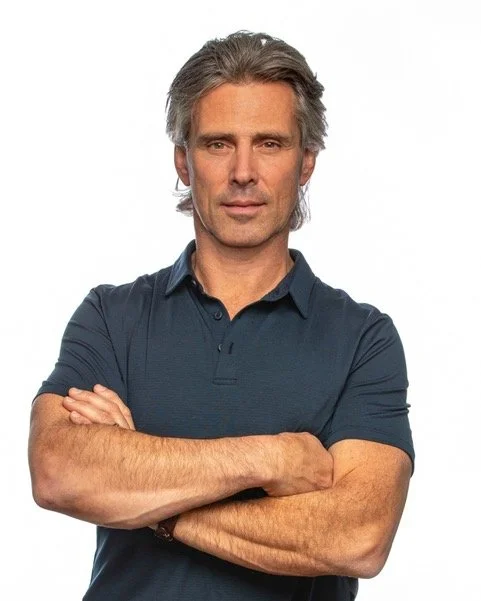
Dr. Sean Fletch's relationship with health began the way most athletes' do — trying to perform better, recover faster, and stay ahead of whoever was competing for his position. Playing cornerback for the University of Guelph, he sustained a spinal injury that could have cost him far more than a season. Chiropractic care returned him to the field for three more years. He graduated from the Canadian Memorial Chiropractic College in 1995, and the athlete's question followed him into the clinic: what actually drives optimal performance — and how do you sustain it?
The honest answer, which took years to fully form, is that he was figuring it out for himself while helping patients. His mentors put it plainly: you can't coach what you don't do. That principle became the foundation of how he practises — not from a position of detached clinical authority, but as someone who has navigated the same inputs, trade-offs, and long game his patients are playing. He wants to be the 90-year-old who functions like a 70-year-old. That goal is the same one he's helping others build toward.
The pursuit took him through post-graduate training in acupuncture, clinical nutrition, and 3D motion biomechanics, and an early clinical sports focus on golf — including a Canadian PGA certification program that trained over 250 professionals in the relationship between efficient movement and physical limitation. That work expanded into hockey, baseball, and athletes across multiple disciplines before the deeper pattern became clear: the movement principles that separate high performers from injured ones are the same principles that determine whether a 70-year-old can still do what matters to them. The biology doesn't change. Only the context does.
Managing concussions in elite athletes led him deeper into brain health — and reinforced what three decades of clinical work had already made clear: the brain is the only organ that cannot be replaced, and it adapts to the same daily inputs as everything else. Sleep, movement, nutrition, stress — these are not lifestyle suggestions. They are signals the nervous system uses to determine what the body becomes.
Over time, Sean shifted his frame from peak performance to trajectory — not where someone is, but where their daily habits are taking them. He relocated Beyond Sports from the GTA to Midland, Ontario, and channelled three decades of clinical observation into a coherent system: the HealthSpan Framework. He has delivered that framework to Fortune 500 organizations including United Technologies, Pratt & Whitney, and Otis Elevator — translating the science of adaptation into practical decisions for high-performing individuals who can't afford to ignore their biology and won't accept vague advice about it.
That system became the foundation of his online education platform and his first book, HealthSpan: Redefined — Biological Principles for the Long Game of Health. He now speaks to entrepreneurs and senior leaders who want to understand the biology behind how they function — and what they can actually do to change its direction.
He still plays hockey. He still golfs. He still trains.
"We don't passively inherit healthspan — we build it through repeated inputs."
To your capacity, Dr. Sean Fletch